



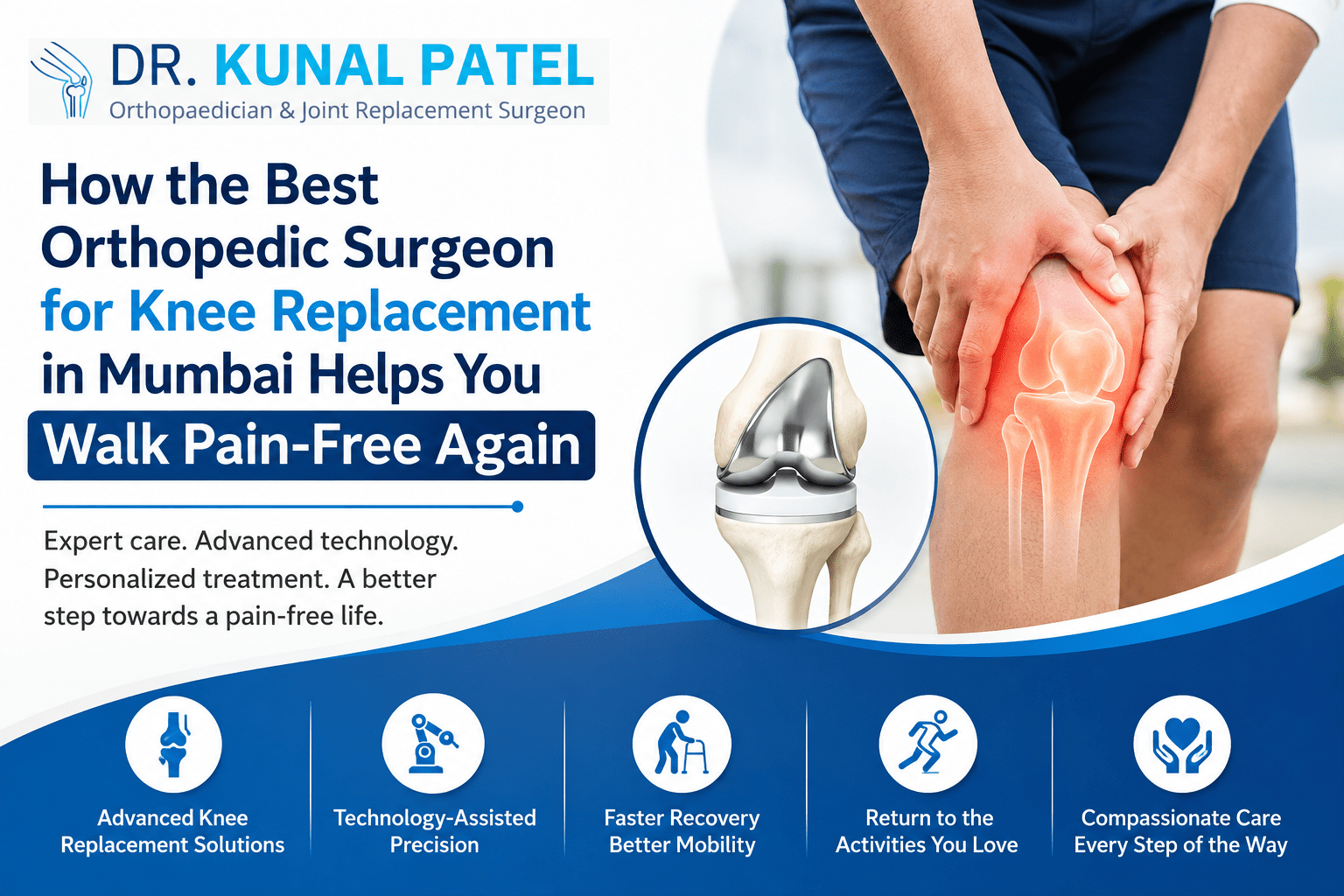
Knee problems can take a big toll on your life. You may start avoiding going out and easily get tired when you do. Eventually, daily activities, like getting out of a chair, can become really difficult. When physical therapy and other conservative treatments no longer ease the pain of your arthritis, damaged cartilage, or a previous knee injury, you may need to consult a knee replacement specialist.
The Best Orthopedic Surgeon for Knee Replacement in Mumbai doesn’t just mean a surgeon with the latest technology. It means a specialist latest technology that has the experience to correctly perform the needed surgery, recommend the various treatment options, and guide you through the process of recovery.
One example of the Best Orthopedic Surgeon for Knee Replacement in Mumbai is Dr. Kunal Patel. He is highly qualified having attained a specialization/MS in Orthopedics. He has done training in joint replacement, and arthroplasty. He also has six joint replacement years of experience in joint replacement surgery and total and partial knee replacement, as well as other orthopedic treatments.
Why Does Knee Pain Affect Your Ability to Walk?
Walking, standing, and doing various tasks around the house all involve the knee. Wearing down of the cartilage of the knee with progressive damage reduces the smooth surfaces of the joint and causes even more pain.
Osteoarthritis accounts for a large percentage of cases of chronic pain in the knee. When cartilage deteriorates, the rubbing of the bones against each other results in pain, stiffness, swelling and decreased range of motion. Long-term problems with the knee can be caused by previous injuries and other joint issues.
Eventually, people begin to change their gait to avoid pain. Although this can help minimize pain in the short run, it greatly increases the difficulty of one’s daily activities and significantly decreases mobility.
When Should You Consider Knee Replacement?
Knee replacement surgery is not the only option available when knee pain occurs. Orthopaedic surgeons consider a patient’s pain, its impact on their daily activities, their medical history, their physical condition, the results of imaging tests, and how well they respond to all the nonsurgical treatments that are available before opting for surgery.
You may need to consider the knee replacement surgery if you have:
- Severe pain that does not subside with daily activities
- Inability to walk or climb stairs
- Hyperekplexia (excessive stiffness) and limited movement
- Pain that doesn’t respond to nonsurgical treatments
- Advanced knee deformity and/or damage
- Pain that disturbs your sleep
Surgery should never be considered just to replace a joint. It should be a way to address all these problems to lessen the pain, give you better movement and alignment, and enable you to do things meaningful to you.
How the Right Orthopedic Surgeon Makes a Difference
When someone decides to undergo knee replacement surgery, the type of surgeon they choose can make a world of difference to the overall experience of the surgery and the recovery process.
1. A Diagnosis That Encourages an Effective Treatment Plan
A good orthopedic surgeon will not simply schedule knee replacement surgery; they will ensure that the source of your knee pain is clearly defined by X-rays or other advanced imaging.
This assessment evaluates the appropriate course of action i.e. whether you require medication, physiotherapy, injections, activity modification, partial knee replacement, total knee replacement, or other types of correction.
2. Choosing the Right Type of Knee Replacement
Not every patient experiences the same concerns. For joint damage in specific and specific locations, treatment may involve a total knee replacement or a partial/unicompartmental knee replacement.
Dr. Kunal Patel’s practice incorporates total knee replacement, partial knee replacement, revision knee surgery, and robotic-assisted knee surgery.
3. Advanced Surgical Technology
In recent years, knee replacement surgery has advanced greatly. New technology enables surgeons to place knee implants using advanced planning methods and techniques.
Dr. Patel’s practice has a section on his website about the use of robotic-assisted surgery in knee replacement and patient-specific technology, including VELYS, VISIONAIRE, TRUMATCH, and similar instruments.
There is a place for new technology in surgery, but it is the surgeon’s experience and understanding of the patient that is critical.
4. Recovery Planning Matters Too
Restoration of knee functionality involves restoring strength and flexibility with balance and confidence Post-surgery.
Your recovery may include supervised physiotherapy with gradual walking and strengthening exercises, with a customized plan of consultations. Recovery requires individualization based on age, health and fitness, chronic conditions, and the extent and type of surgery.
The goal is to recover at your pace rather than recovering quickly.
From Painful Steps to Confident Walking
You may be able to walk around your neighborhood or climb stairs without as much thought for your knee.
Knee surgery aims to restore function by replacing damaged knee surfaces with artificial surfaces. With the proper rehabilitation surgery can give patients the ability to regain mobility and become more active in their daily lives.
Factors such as the health and age of the patient, how well the patient follows the recovery instructions of the surgery, the technique of the surgery, how well the patient rehabilitates, and the health of the knee prior to surgery all play a part in the final outcome of the surgery.
What About Muscle and Sports Injuries?
Not all knee or leg problems warrant knee replacement.
A hamstring strain for example occurs in a muscle posterior (at the back) of the thigh. It can occur with a sudden change in pace, a stop, a sports activity, a lack of flexibility, and a muscle imbalance. This can cause pain, soreness, and swelling, and can make it difficult to walk and bend the knee.
For patients looking for Hamstring Strain Treatment in Mumbai, an orthopaedic assessment can help determine the severity of the injury and guide treatment. Depending on the injury, management may involve rest, ice, compression, rehabilitation exercises, physiotherapy, and a gradual return to activity.
It is important to understand that an injury to your hamstring is different from diseased arthritic knee.
Why Patients in Mumbai Choose Dr. Kunal Patel
Dr. Kunal Patel offers orthopaedic and joint replacement services for patients residing in the western suburbs of Mumbai, which include Borivali, Kandivali, Malad, Goregaon, Andheri, and Dahisar. His practice specializes in total knee replacements, partial knee replacements, robotic knee replacements, knee arthroscopies, hip replacements, the management of sports injuries, and joint replacements and rehabilitation.
Dr. Patel’s website states that he has 15+ years of experience, with more than 5,000 patients treated and more than 3,000 successful surgeries.
Frequently Asked Questions
1. Who is the best knee replacement surgeon in Mumbai?
You must seek the advice of a qualified orthopaedic surgeon to assess your knee condition. Dr. Kunal Patel offers knee replacements in Borivali West, Mumbai.
2. Is a knee replacement suitable for every person suffering from chronic knee pain?
No. Knee replacement is only rarely used when significant damage to the joint and chronic symptoms adversely impact quality of life and attempts with other therapies have been unsuccessful. Surgery is only indicated when assessment by a specialist has been undertaken.
3. How soon after surgery can I anticipate being able to walk?
The time to walking after surgery will depend upon the surgery, your health, the degree of your mobility, as well as the rehabilitation protocol of your surgeon. Many patients are able to begin assisted walking movements shortly after surgery, with progressive physiotherapy and strengthening.
4. What is the meaning of robotic-assisted knee replacement surgery?
This is a kind of knee replacement surgery that makes use of robotics to assist the surgeon with the planning of the surgery and positioning of the implants. While it is designed to help a surgeon plan and improve the accuracy of the surgery, it does not replace the surgeon.
5. Is surgery always the solution for healing an injured hamstring?
No. Most hamstring injuries are best treated by rest, rehabilitation, and physiotherapy followed by a gradual return to activity/sport. How the injury is treated will depend upon the severity of the injury.
6. Which clinic of Dr. Kunal Patel can be approached in Mumbai?
Dr. Kunal Patel can be consulted at his clinic located at Punit Hospital, Punit Nagar, S. V. Road, Borivali West, Mumbai 400092.
Give some thought to consulting an orthopaedic and joint replacement specialist to see if knee pain is interfering with your walking, going up or down the stairs, or affecting your sleep or your independence.
NAP: Dr. Kunal Patel’s Clinic
Name: Dr. Kunal Patel — Consultant Orthopaedic & Joint Replacement Surgeon
Address: Punit Hospital, Punit Nagar, S. V. Road, Opp. Indian Oil Petrol Pump, Near Poisur Bus Depot, Borivali West, Mumbai – 400092
Phone: +91-9372737914
Email: drkunalpatel@gmail.com
Clinic Hours: Monday–Saturday, 9:00 AM–11:00 AM and 5:00 PM–8:00 PM; Sunday closed.
For the latest appointment information, patients should confirm details directly with the clinic.
Connect With Dr. Kunal Patel Online
- Website: drkunalpatel.com
- Facebook: https://www.facebook.com/Dr.KunalPatel.Mumbai
- Instagram: https://www.instagram.com/drkunalpatel5926/
Author Info

No Comments